/* ── DONATE ── */ .nav-donate { display: flex; align-items: center; margin-left: 0.5rem; } .footer-donate { display: flex; align-items: center; }
φ

Project Phi Grid — Independent Research

Is the golden ratio
encoded in space?

A rigorous statistical investigation into whether φ-ratio geometry structures the Earth, the solar system, and the stellar neighbourhood.

φ Golden Ratio
1.6180…
p=0.010 Earth paper
significance
11 Anchors tested
2 significant
OSF Pre-registered
osf.io/a72fp
Read the Earth Paper Explore the Results

What is Phi Grid?

Project Phi Grid tests a precise, falsifiable hypothesis: that the golden ratio φ structures the geometry of natural systems at multiple scales — from Earth's surface to the stellar neighbourhood — at levels of statistical significance that cannot be explained by chance.

φ = (1 + √5) / 2 The Golden Ratio ≈ 1.6180339887…

The golden ratio φ appears throughout nature — in nautilus shells, sunflower seeds, and galaxy spirals. Phi Grid asks whether this isn't coincidence: whether φ actually governs how structures are spaced at cosmic scales.

We test this with real data, pre-registered hypotheses, and rigorous statistics. If φ-shells anchored at Neptune predict where nearby stars cluster — and no other anchor does — that demands explanation.

The core test: KDE of radial stellar distances (volume-corrected, bandwidth 0.8 ly) against φ-ratio geometric progressions rₙ = r₀ × φⁿ. Monte Carlo null distributions constructed from N=100,000 random geometric progressions and random position sets.

Anchor specificity: 11 candidate anchors tested. Only Neptune (30.069 AU) and Kuiper Belt outer edge (~50 AU) return p<0.05. Inner solar system bodies, heliopause, and Oort Cloud all return p>0.75. Pre-registration: OSF osf.io/a72fp.

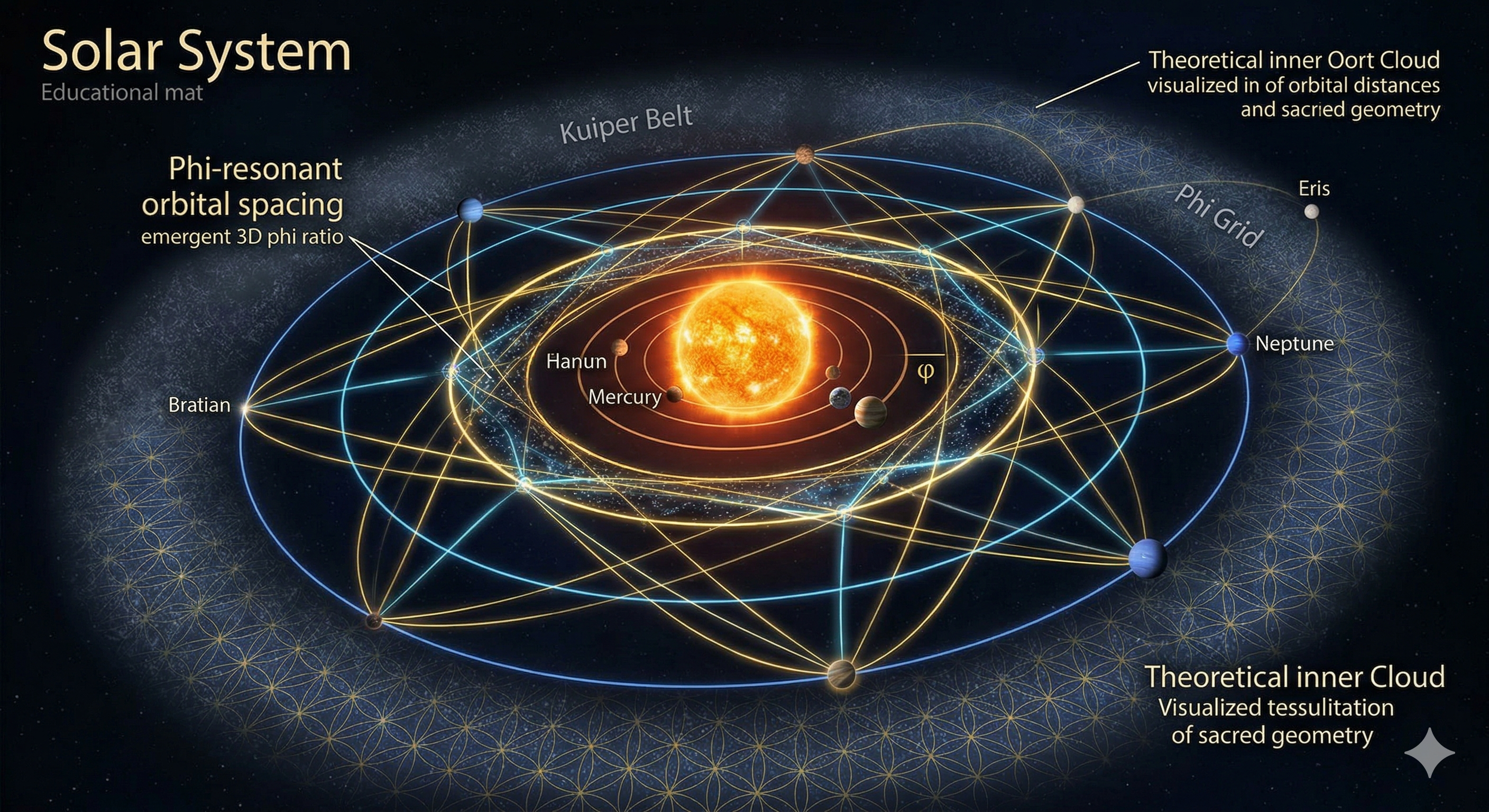
φ-Shell Series from Neptune
r₀ = 1.663 ly
r₁ = r₀ × φ = 2.692 ly
r₂ = r₁ × φ = 4.355 ly
r₃ = r₂ × φ = 7.047 ly
r₄ = r₃ × φ = 11.402 ly ✓
r₅ = r₄ × φ = 18.448 ly
r₆ = r₅ × φ = 29.850 ly
r₇ = r₆ × φ = 48.298 ly ✓
Shells predicted purely from Neptune's orbital radius and φ. No free parameters.

Three papers.
What we found.

Each result is accompanied by its p-value, dataset, and pre-registration record. Null results are reported alongside positive ones.

01
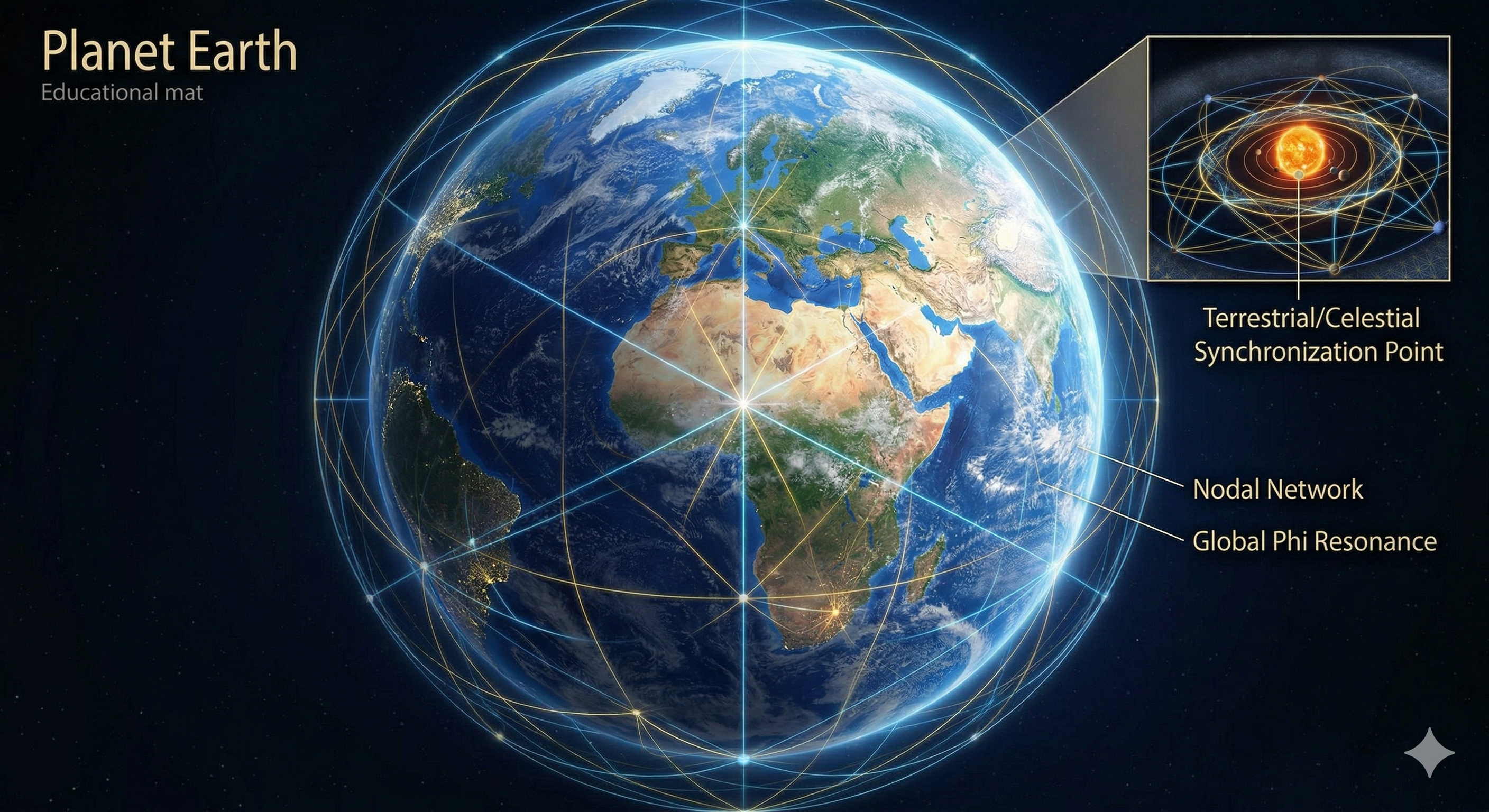
Earth Paper — φ-Grid at Geophysical Sites
A 16-petal φ-ratio grid anchored at the Wilkes Land mascon aligns with major geophysical and archaeological sites worldwide. Monte Carlo N=10,000. Under active review by Dr. C. Beggan, British Geological Survey.
p = 0.0102
02
Stellar Neighbourhood — φ-Shells from Neptune
φ-ratio shells anchored at Neptune (30.069 AU) align with stellar density peaks in the RECONS/Hipparcos 58-system catalog within 20 ly. KDE detects 4 peaks; 3/4 shells match within ±0.5 ly. N=100,000.
p = 0.0285
03
Gaia GCNS Confirmatory Test — Pre-Registered
Pre-registered extension to 1,148 Gaia sources within 50 ly. 2/8 shells matched at 50 ly — below the pre-registered significance threshold. Honest null result: the Section 13 signal does not survive at 50 ly. Partial concordance (0–20 ly zone) under investigation.
p = 0.176 — NULL
Scientific Integrity Note

The Gaia null result is reported prominently and without spin. Pre-registered science means the hypothesis is tested honestly — a null result is a result. The partial 0–20 ly concordance is currently under investigation as a focused replication study.

Only Neptune is significant.
11 anchors tested.

The most important control in this research: the same test was run identically on 11 candidate anchors spanning the solar system. Inner planets, the Sun, the heliopause, and the Oort Cloud all return null. Only the outer Neptune/Kuiper boundary is significant — both physically meaningful anchors that mark the edge of Neptune's dynamical zone.

Anchor Distance (AU) p-value Significant?
Mercury0.387> 0.75No
Venus0.723> 0.75No
Earth1.000> 0.75No
Mars1.524> 0.75No
Jupiter5.203> 0.75No
Saturn9.537> 0.75No
Uranus19.191> 0.75No
Neptune30.0690.0285Yes ★
Kuiper Belt outer edge~500.0285Yes ★
Heliopause~120> 0.75No
Oort Cloud (inner)~2,000> 0.75No

★ Both significant anchors mark the outer boundary of Neptune's dynamical zone. Citation: Volk et al. 2019, AJ 158 64. DOI: 10.3847/1538-3881/ab2c3b

From Earth to the
stellar neighbourhood.

2024 — 2025
Earth Paper — φ-Grid Geophysical Analysis
16-petal φ-ratio grid anchored at Wilkes Land mascon. Monte Carlo N=10,000, p=0.0102. First publication of the Phi Grid methodology.
Zenodo DOI: 10.5281/zenodo.19035389 →
Early 2026
BGS Review — Correspondence with Dr. C. Beggan
Dr. Conall Beggan, British Geological Survey, initiates review of the Earth paper. Correspondence ongoing. 11 downloads of v13 on Zenodo analytics suggest team-level engagement.
March 2026
Section 13 — Stellar Neighbourhood (RECONS/Hipparcos)
φ-shells from Neptune tested against 58-system catalog within 20 ly. p=0.0285. Anchor specificity test across 11 solar system bodies: only Neptune/Kuiper significant.
Zenodo DOI: 10.5281/zenodo.19241818 →
25 March 2026
Pre-Registered Gaia GCNS Confirmatory Test
Hypothesis pre-registered on OSF before any Gaia data downloaded. 1,148 sources within 50 ly. Null result at 50 ly (p=0.176). Partial 0–20 ly concordance documented. Null reported openly.
OSF Pre-registration: osf.io/a72fp →
26 March 2026
Outreach to Prof. Avi Loeb — Harvard / Galileo Project
Correspondence initiated with Prof. Abraham Loeb regarding the stellar neighbourhood findings and their potential relevance to structured astronomical phenomena.
27 March 2026
Solar System φ-Shell Pre-Registration — OSF
Pre-registered confirmatory test of φ-shells anchored at Neptune (30.069 AU) against 4 solar system boundaries within ±5% tolerance. Significance threshold p<0.05. Registered before any analysis is run.
OSF Pre-registration: osf.io/3p2gb — DOI: 10.17605/OSF.IO/3P2GB →
Upcoming — March 2026
Archaeological Sites Paper
Dedicated analysis of φ-ratio grid alignment with global archaeological sites. The Earth paper (DOI: 10.5281/zenodo.19035389) establishes the geophysical framework; this paper focuses specifically on the archaeological dimension of the signal. Notebook prepared, paper in progress.
Upcoming
Focused 0–20 ly GCNS Replication (Binaries Collapsed)
Direct replication of Section 13 on Gaia GCNS data with binaries collapsed via gcns.resolvedss. 83 systems. Methodology-matched comparison.
Upcoming
Negative Result Paper — RNAAS / A&A Letters
Pre-registered null results are publishable. Earth paper + Section 13 + Gaia confirmatory null = complete, honest research arc.

Open access.
Every dataset, every result.

All papers, notebooks, and pre-registrations are publicly available. Reproducibility is a core commitment of this project.

Scientists, journalists,
and curious minds welcome.

Whether you're a researcher interested in collaboration, a journalist covering independent science, or a member of the public with questions — reach out.

Powered by Formspree. No data is sold or shared.